Structure
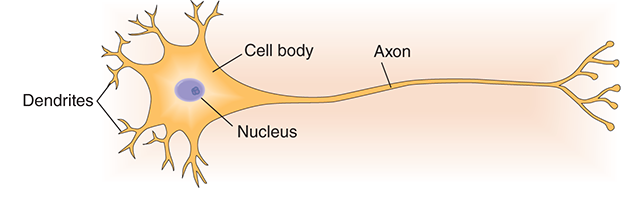
Neurons consists of multiple dendrites, a cell body or soma, an axon, and a presynaptic terminal.
-
-
The soma (cell body) contains the cell nucleus and the rough endoplasmic reticulum.
-
The axon is the cellular process that carries action potentials away from the soma.
Axons are often long and may have multiple branches.-
Dendrites t receive impulses from other neurons. Many neurons have an extensive set of dendrites, referred to as the dendritic tree.
-
- The table summarizes terms that apply to collections of neurons where cell bodies are concentrated and terms used to describe collections of axons.
-
-

They are the nondividing
Clumps of rough endoplasmic reticulum (RER) and polyribosomes (referred to as Nissl bodies) are only found in the cell body and dendrites (not axon).
The cell body is comprised of the nucleus and nucleolus, the surrounding cytoplasm, and the plasma membrane
The trigger zone for the initiation of impulse sis the axon hillock. The initial segment, immediately after the axon hillock, contains no myelin sheath but does contain a very high density of voltage-gated Na+ channels for continued propagation of the nerve impulse.
Graphic

In the myelinated section, the impulse is conducted from node to node (see below) until reaching the terminal boutons where neurotransmitter molecules are stored for release and nerve signal propagation.
Content 2
Content 3
Each neuron has a variable number of dendrites (cytoplasmic processes that receives stimuli or messages via chemoreceptors and carry them toward the soma).