Hemostasis
Hemostasis is the process of blood clot formation at the site of vessel injury.
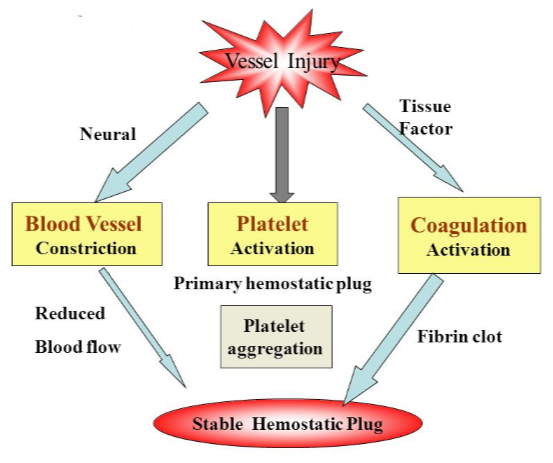
Clot Retratction and Fibrinolysis

2. Platelet plug formation
Exposed collagen at the injury site causes platelets to adhere and become activated[3]. The activated platelets release chemicals that attract more platelets, forming a platelet plug that temporarily seals the wound[1][5].
4. Clot retraction and fibrinolysis
In the final stage, the clot retracts and is gradually dissolved as the damaged tissue heals[3]. Plasmin, activated by tissue plasminogen activator (tPA), breaks down the fibrin clot in a process called fibrinolysis[3].
These steps work together to quickly stop bleeding, prevent infection, and allow for tissue repair following an injury to a blood vessel[1][3][5].
Citations:
[1] https://my.clevelandclinic.org/health/symptoms/21999-hemostasis
[2] https://courses.lumenlearning.com/suny-ap2/chapter/hemostasis/
[3] https://books.byui.edu/bio_381_pathophysiol/312__the_stages_of_h
[4] https://truerescue.com/blogs/knowledge/steps-of-hemostasis
[5] https://pressbooks-dev.oer.hawaii.edu/anatomyandphysiology/chapter/hemostasis/